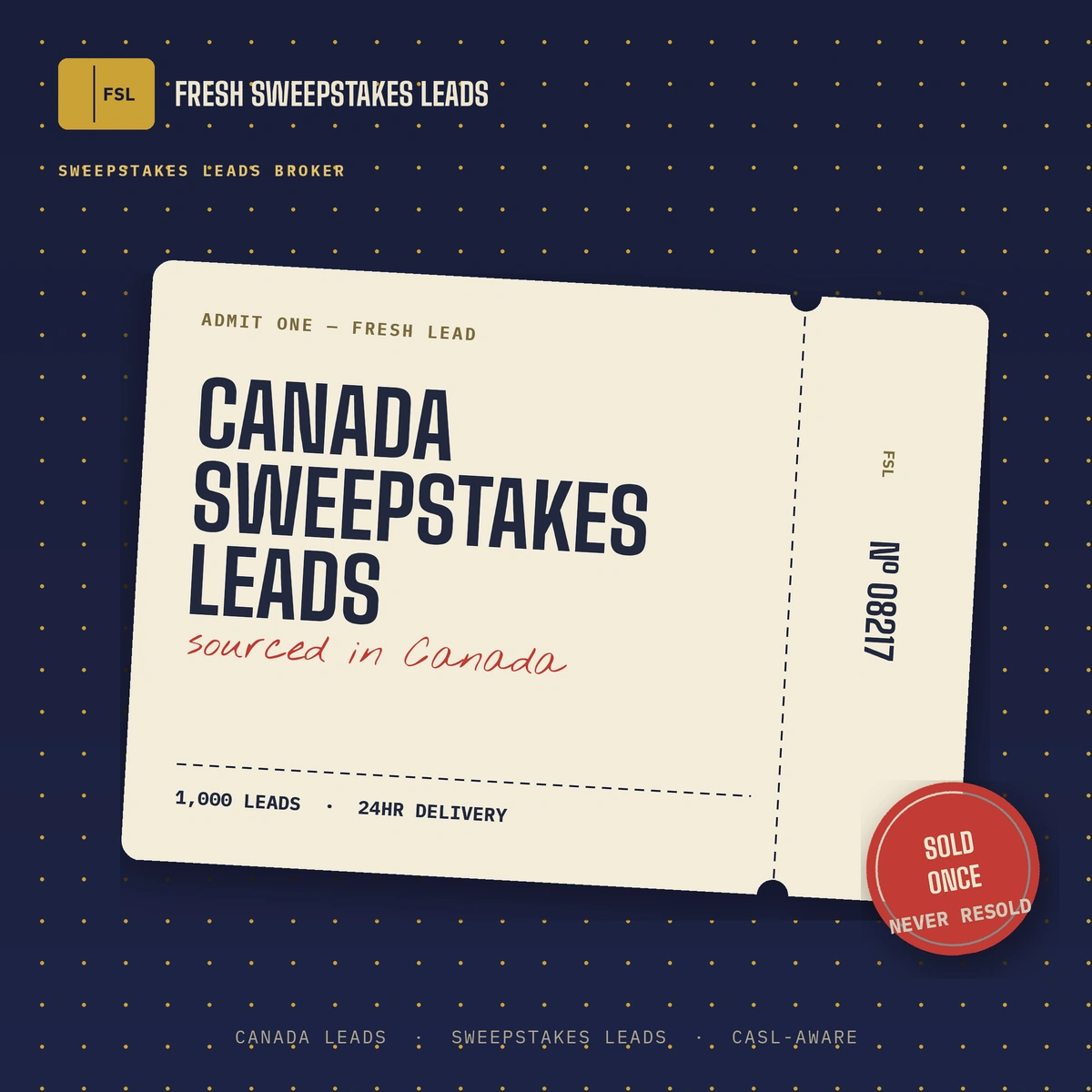
Description
Sweepstakes Leads for the Canadian Market: CASL, Compliance, and What’s Different From the U.S.
Marketers who’ve built a playbook around U.S. sweepstakes leads often assume expanding into Canada is as simple as filtering a list by country. It isn’t. Canada has its own consent laws, its own telemarketing rules, and in Quebec specifically its own language requirements for commercial communication. Treating Canadian leads as a geographic subset of U.S. inventory is one of the most common mistakes marketers make when expanding north, and it’s usually the reason a campaign that worked well in the U.S. underperforms or runs into compliance trouble in Canada.
Why Canadian Sweepstakes Leads Aren’t Just U.S. Leads With a Border Filter
A genuinely Canadian sweepstakes lead should be sourced from an entry page a Canadian consumer actually saw and completed with a Canadian address, province, and postal code not a U.S. list filtered down to whatever records happen to have a Canadian-looking ZIP. This distinction matters for two reasons.
First, data quality: a sweepstakes or giveaway page built for a U.S. audience often isn’t promoted to Canadian consumers at all, so filtering a U.S. list for Canadian records usually just produces a small, low-quality subset rather than a properly sourced list. Second, and more importantly, compliance: Canadian consumers are covered by different consent laws than U.S. consumers, and a lead captured under U.S.-style disclosure language may not satisfy Canadian requirements even if the person happens to live in Canada.
CASL vs. TCPA: What Actually Changes for Marketers
Canada’s Anti-Spam Legislation (CASL) is the law most marketers have heard of when it comes to Canadian compliance, but it’s often misunderstood including, frequently, exactly what it does and doesn’t cover.
What CASL Actually Covers
CASL governs commercial electronic messages (CEMs), text messages, and certain social media or instant messages sent for a commercial purpose. For these channels, CASL generally requires:
- Consent (express or implied) before sending a commercial electronic message
- Clear identification of the sender
- A working unsubscribe mechanism in every message
Express consent under CASL is generally considered stronger and more durable than implied consent, and the rules around what counts as valid consent are more specific than equivalent U.S. email marketing law. This is the main reason CASL has a reputation as “stricter than the U.S.” for email and SMS specifically, it is.
What CASL Does Not Cover
Here’s the detail that trips up a lot of marketers moving from the U.S. market: CASL does not govern telemarketing phone calls. Voice calls in Canada fall under a separate framework the CRTC’s Unsolicited Telecommunications Rules and the National Do Not Call List (DNCL) which is a different regulatory system with its own registration and compliance requirements, roughly analogous to the U.S. National Do Not Call Registry and TCPA calling rules, but not identical to either.
In practice, this means a Canadian outbound calling campaign needs to be evaluated against Canada’s telemarketing and DNCL rules, while a Canadian email or SMS campaign needs to be evaluated against CASL. Treating one as a stand-in for the other is a common and avoidable mistake.
Quebec: A Compliance Layer of Its Own
Beyond CASL and telemarketing rules, Quebec adds a dimension most U.S. marketers don’t anticipate: language law. Quebec’s Charter of the French Language (updated by Bill 96 in 2022) sets requirements around the use of French in commercial communication and consumer contracts within the province. For marketers running campaigns that include Quebec consumers, this is a genuinely separate compliance consideration from CASL or telemarketing rules it’s about the language of your marketing and contractual materials, not consent to be contacted.
This is a good example of why “Canada compliance” isn’t a single checkbox. A campaign that’s fully CASL-compliant and DNCL-compliant can still run into trouble in Quebec specifically if the language requirements aren’t addressed. Any marketer running Canada-wide campaigns should treat Quebec as requiring its own review rather than assuming national compliance automatically covers it.
What to Look for in a Canada-Specific Lead Source
Given these differences, evaluating a Canadian sweepstakes lead vendor requires a few extra questions beyond what you’d ask for U.S. leads:
1. Is the entry page actually promoted to Canadian consumers?
Ask whether the sweepstakes or giveaway placement was run specifically in the Canadian market, rather than a U.S. campaign that happened to collect some Canadian entries.
2. What consent language was shown at the point of entry?
For any data you intend to use for email or SMS outreach, the disclosure shown to the entrant should be sufficient to support CASL consent requirements. Ask your vendor directly whether their capture process was built with CASL in mind.
3. Are records mapped to Canadian provinces and postal codes correctly?
This sounds basic, but formatting matters for both usability and for provincial-level compliance considerations like Quebec’s language rules you need to be able to identify which records are in Quebec to apply the right marketing materials.
4. Is this list exclusive, and how fresh is it?
The same freshness and exclusivity questions that apply to U.S. sweepstakes leads apply here first-hit, single-buyer data outperforms aged or shared lists in Canada just as it does in the U.S.
Verticals That Perform Well in the Canadian Market
The general demographic and vertical patterns from the U.S. sweepstakes lead market largely hold in Canada, with a few market-specific notes:
- Insurance (home, auto, life) performs consistently well, similar to the U.S. pattern.
- Home services campaigns do well in Canadian provinces with strong homeownership rates, though provincial licensing requirements for contractors and service providers should be confirmed independently of lead sourcing.
- Financial services marketers should note that Canadian financial marketing has its own regulatory bodies (distinct from U.S. equivalents) that may apply on top of CASL and telemarketing rules, depending on the product.
How to Structure a Compliant Canadian Outreach Campaign
A reasonable approach for a marketer building a Canadian campaign for the first time:
- Separate your channels. Confirm CASL compliance for email/SMS and telemarketing/DNCL compliance for phone calls as two distinct workstreams, not one combined “Canada compliance” checklist.
- Flag Quebec records separately. If your list includes Quebec entrants, route them through a review for French-language material requirements before launch.
- Confirm your lead vendor’s capture process, rather than assuming a “sweepstakes lead” from any source meets Canadian consent standards by default.
- Loop in legal counsel familiar with Canadian marketing law before scaling — this guide is meant to help you ask the right questions, not to substitute for a compliance review specific to your business and offer.
Frequently Asked Questions
Does CASL apply to phone calls?
No. CASL governs commercial electronic messages like email and text. Telemarketing phone calls in Canada are governed separately by the CRTC’s Unsolicited Telecommunications Rules and the National Do Not Call List.
What’s the difference between express and implied consent under CASL?
Express consent is a clear, affirmative opt-in from the recipient. Implied consent arises in narrower circumstances defined by the law, such as an existing business relationship, and is generally considered less durable than express consent. Marketers relying on implied consent should confirm their specific situation qualifies under CASL’s definitions.
Is Quebec compliance different from the rest of Canada?
Yes, in an additional way. Beyond CASL and telemarketing rules that apply nationally, Quebec’s Charter of the French Language adds requirements around French-language use in commercial communications that don’t apply in other provinces.
Can I just filter my U.S. sweepstakes leads list for Canadian addresses?
You can, but it typically produces a small, low-quality subset rather than a properly sourced Canadian list, and doesn’t guarantee the consent language shown to those entrants meets Canadian standards. Purpose-sourced Canadian leads are generally a better foundation for a Canadian campaign.
Which verticals perform best with Canadian sweepstakes leads?
Insurance and home services follow similar patterns to the U.S. market. Financial services marketers should also account for Canada-specific regulatory bodies that may apply alongside CASL and telemarketing rules.
The Bottom Line
Canada isn’t a smaller, filtered version of the U.S. market when it comes to sweepstakes leads it has its own consent framework for electronic messages (CASL), a separate system for telemarketing calls, and province-specific rules like Quebec’s language requirements that don’t have a U.S. equivalent. Marketers who source Canadian leads specifically, ask the right questions about how consent was captured, and treat compliance as channel-specific rather than one general rule tend to avoid the most common and costly mistakes when expanding a sweepstakes lead strategy north of the border.



Reviews
There are no reviews yet.