
Description
PCH Leads Explained: Why PCH Sweepstakes Leads Convert Differently (And Who Should Buy Them)
Not all sweepstakes leads perform the same way for every offer. A list that converts well for a home services campaign might underperform for a Medicare offer, and vice versa. Understanding why comes down to one factor buyers often overlook when comparing lead vendors: the entry page format shapes who actually enters, and that shapes how the resulting list performs.
What Makes a Lead a “PCH Lead”
PCH leads take their name from the sweepstakes format many consumers instantly recognise, large-prise, mail-and-web giveaway pages with broad, long-running brand familiarity. It’s worth being precise about what that name does and doesn’t mean: “PCH leads” is industry shorthand describing leads sourced from that style of sweepstakes and giveaway page. It is not a claim of affiliation with, endorsement by, or data sourced from Publishers Clearing House itself. Any broker selling PCH leads should be upfront about that distinction, and buyers should be cautious of any vendor implying an official partnership with a specific sweepstakes brand.
What actually differs between a PCH lead and a generic sweepstakes lead is the entry page itself the prise structure, the visual format, and the recognisability of the giveaway style. That format doesn’t attract a random cross-section of internet users; it attracts a specific kind of entrant, and that’s where the real value for buyers comes from.
The Demographic Pattern Behind PCH Leads
Because PCH-format giveaways have decades of brand recognition behind the general format, the entrants they draw skew differently than leads from smaller, niche digital sweepstakes. In practice, buyers consistently report that PCH-format entrants:
- Skew older, often 55 and up
- Are more likely to be homeowners
- Respond more consistently to phone and direct mail outreach than to purely digital follow-up
- Show higher engagement with recognisable, familiar prize and giveaway formats than with newer or more obscure sweepstakes brands
This isn’t a guarantee for every individual record no lead list is perfectly uniform but it’s a consistent enough pattern that entire verticals build their buying strategy around it.
Why This Matters for Vertical Fit
Understanding this demographic pattern is the single most useful thing a buyer can do before purchasing PCH leads, because it directly predicts which offers will perform well and which won’t.
Medicare and Health Plan Marketing
This is the vertical where PCH leads typically perform strongest. Medicare eligibility begins at 65, and PCH-format entrants’ age skew lines up closely with that target audience. Buyers in this space often pair PCH leads with phone outreach, since older demographics tend to respond well to a direct conversation over a purely digital funnel.
One important note for this vertical specifically: Medicare marketing is subject to CMS (Centers for Medicare & Medicaid Services) communication rules that go beyond general TCPA compliance. Any organisation marketing Medicare plans should have its own compliance review process independent of lead sourcing a fresh, well-sourced lead doesn’t remove the marketer’s own obligation to follow CMS marketing guidelines.
Insurance (Auto, Home, Life)
Homeowners insurance and life insurance campaigns also tend to perform well with PCH-format leads, given the homeowner skew. Auto insurance results vary more, since that offer isn’t as tightly correlated with the older demographic PCH leads tend to attract buyers running auto campaigns sometimes get better results blending PCH leads with standard sweepstakes leads rather than relying on PCH data exclusively.
Home Services (Roofing, Solar, HVAC)
Home services offers depend on homeownership more than any single demographic trait, which makes PCH leads a strong match given their homeowner skew. Solar and HVAC campaigns in particular tend to see reasonable performance, since both offers appeal to homeowners across a fairly wide age range that overlaps well with PCH entrant demographics.
Personal Finance and Debt Relief
Results here are more offer-dependent. Debt relief and certain finance products can perform well with an older demographic, but personal finance offers aimed at younger consumers (student loan refinancing, for example) are a poor match for PCH-format leads specifically a standard sweepstakes lead with different demographic filtering would be a better fit.
PCH Leads vs. Standard Sweepstakes Leads vs. Handwritten Sweepstakes Leads
It’s easy to conflate these three product types, but they answer different questions:
- Standard Sweepstakes Leads answer “who recently opted in to be contacted?” with broad demographic filtering, suited to high-volume outbound programs across a wide range of verticals.
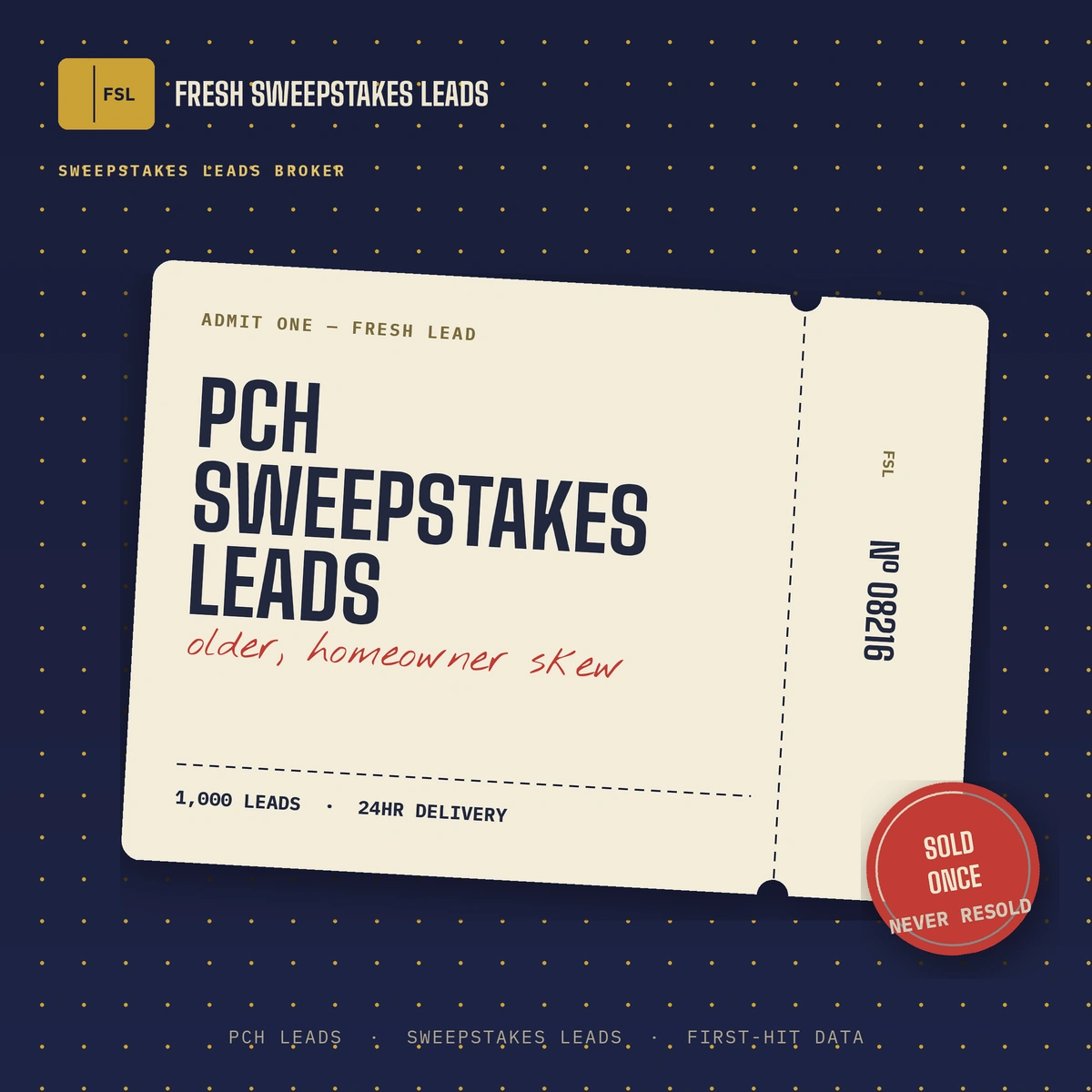
- PCH Sweepstakes Leads answer the same question but filtered toward a specific entry format that skews older and homeowner-heavy — the right choice when your offer specifically targets that demographic.
- Handwritten Sweepstakes Leads answer a channel question, not a demographic one the same underlying entrant data (which can itself be PCH-format or standard) packaged for handwritten mail campaigns instead of phone outreach.
A buyer targeting Medicare via direct mail, for instance, might specifically want PCH-format leads packaged as a handwritten sweepstakes leads product combining the demographic fit of PCH data with the response advantage of handwritten mail.
How to Evaluate Whether PCH Leads Are Right for Your Campaign
Before buying, it’s worth running through a short checklist:
1. Does your offer’s ideal customer skew older or homeowner-heavy?
If yes, PCH leads are likely to outperform standard sweepstakes leads for the same budget.
2. Is your outreach channel phone or mail?
PCH-format entrants tend to respond better to these channels than to email-only follow-up.
3. Does your vertical have additional compliance requirements?
Medicare marketing in particular carries CMS-specific rules beyond general TCPA compliance confirm your own compliance process is aligned before scaling any campaign, regardless of lead source.
4. Can your vendor confirm the leads are first-hit and exclusive?
This matters as much for PCH leads as for any other sweepstakes lead ask whether the record has been sold to other buyers before it reaches you, and whether it will be resold after your campaign window.
5. Are you filtering on top of the demographic skew, or relying on it alone?
PCH sourcing shifts the odds toward an older, homeowner-heavy list, but it isn’t a substitute for additional filtering. A buyer targeting Medicare Advantage plans, for example, still benefits from age-range filtering on top of PCH sourcing, rather than assuming the format alone is precise enough. Treat PCH sourcing as one layer of targeting, not the only one.
Blending PCH Leads With Other Sources
Few high-performing campaigns rely on a single lead source exclusively. It’s common and often advisable to blend PCH leads with standard sweepstakes leads or other filtered lists, particularly for offers that sit at the edge of the PCH demographic pattern, like auto insurance or general personal finance products. A buyer running a mixed campaign might allocate a larger share of budget to PCH leads for a Medicare or home services offer, while keeping a lighter allocation of standard leads to catch prospects who fall outside the typical PCH entrant profile but still match the offer. Tracking conversion separately by source, rather than blending the results together, is the only reliable way to know whether that mix is actually working.
A Note on Realistic Expectations
It’s worth being direct about one thing: demographic skew is a pattern, not a guarantee for any individual record. A batch of PCH leads will include some entrants who don’t fit the typical profile, just as a batch of standard sweepstakes leads will include some who do. The value of PCH-format sourcing is in shifting the odds of your list matching your target customer not in guaranteeing every record fits. Buyers who track conversion by batch (as covered in more detail in a companion buyer’s guide) get a much clearer picture of how well PCH leads are actually performing for their specific offer than buyers who judge based on assumptions alone.
Frequently Asked Questions
Are PCH Sweepstakes Leads officially connected to Publishers Clearing House?
No. “PCH leads” is industry terminology describing leads sourced from a PCH-style giveaway page format, not data provided by or affiliated with Publishers Clearing House.
Why do PCH leads convert better for some offers and not others?
PCH-format giveaway pages tend to attract an older, homeowner-skewing entrant base. Offers that target that demographic Medicare, insurance, home services tend to see stronger results than offers targeting younger consumers.
Is there a compliance difference between PCH leads and standard sweepstakes leads?
The underlying consent and TCPA considerations are the same. The main additional consideration is vertical-specific: Medicare marketers using PCH leads should follow CMS marketing communication rules on top of general lead compliance.
Should I buy PCH leads or standard sweepstakes leads for my campaign?
If your offer’s ideal customer skews older or is likely to be a homeowner, PCH leads are usually the stronger choice. For younger or more general audiences, standard sweepstakes leads with appropriate filtering are typically a better fit.
Can PCH leads be used for mail campaigns?
Yes, PCH-format entrant data can be packaged as handwritten sweepstakes leads for mail campaigns, combining the demographic advantages of PCH sourcing with the response benefits of handwritten-style outreach.
The Bottom Line
PCH Sweepstakes Leads aren’t simply a rebranded version of standard sweepstakes leads the entry format behind them shapes a genuinely different entrant demographic, which is why they perform differently by vertical. Medicare, insurance, and home services buyers tend to see the strongest results; buyers targeting younger or more general audiences are usually better served by standard sweepstakes leads. Matching the lead source to your actual target customer, rather than defaulting to whichever product sounds most familiar, is what separates a well-optimised lead-buying strategy from a wasteful one.
Reviews
There are no reviews yet.